Category: Physicians | Medical Education | Advanced Certification Institute
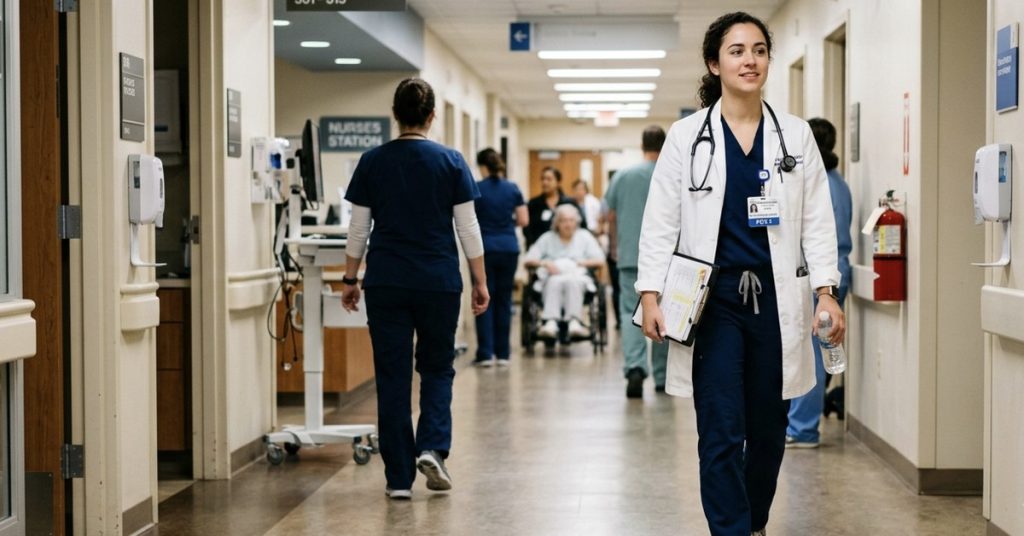
Your white coat still smells new. Your badge photo is the only thing about you that looks calm right now. And somewhere between orientation slides and your first overnight call, it’s going to hit you: nobody is going to check your work the way an attending checked it in medical school. You’re the one signing the note now.
That shift — from supervised learner to accountable clinician — is the entire story of July. It happens to every resident, every year, in every teaching hospital in the country. Knowing what’s coming doesn’t make it easy. It makes it survivable.
Why July Is Different From Every Other Month
Teaching hospitals run on a hard reset every July 1. A new class of interns starts writing orders. Second- and third-years step into more senior roles. Attendings absorb more oversight than they carried in June. The entire system re-forms at once, and the research bears out what every nurse and attending already knows: this transition creates friction.
One widely cited analysis found fatal medication errors spike roughly 10% in July in counties with teaching hospitals — and nowhere else. Other studies on length of stay, complication rates, and efficiency show more mixed results; some find no measurable effect at all. The honest read is this: the “July effect” isn’t a guaranteed disaster, but it’s a real period of elevated risk, driven by unfamiliarity — with the EMR, with the floor plan, with who to call and how fast they’ll pick up.
You don’t control the system-wide numbers. You control how fast you close your own knowledge and communication gaps. That’s the job this month.
What to Expect in the First Few Weeks
Expect to feel behind, even when you’re not. Expect to spend more time locating supplies, finding the right extension, and re-reading the same order set than you’d like. Expect senior residents and attendings to double-check your plans more closely than they will in six months — that’s not a lack of trust, it’s the system working as designed.
Expect long stretches where the job is mostly listening: to attendings on rounds, to nurses flagging a change before it’s obvious on paper, to patients describing symptoms that don’t match the textbook. Residency rewards people who take detailed notes, ask direct questions, and don’t guess when they’re unsure.
What to Actually Look Forward To
The steepest learning curve of your career is also the fastest. Most residents look back on the first 90 days as the period they grew the most as clinicians — not because it was comfortable, but because the stakes forced real competence, fast. You’ll go from hesitating over a med reconciliation to running one without thinking about it. You’ll go from silently panicking at a deteriorating patient to calling it, acting, and knowing why.
You’ll also build the relationships that carry the rest of your training — the senior resident who taught you how the unit actually works, the nurse who caught what you missed and told you calmly instead of writing you up. Those relationships are worth investing in from week one.
What to Watch Out For
Fatigue compounds mistakes. Sleep deprivation degrades judgment well before it degrades your ability to notice you’re impaired. Protect sleep aggressively, especially heading into a stretch of call.
Silence is more dangerous than a “wrong” question. The residents who struggle most in July aren’t the ones who ask too much — they’re the ones who don’t ask at all because they don’t want to look inexperienced. Every attending in a teaching hospital has heard worse questions than yours.
Know your escalation path before you need it. Learn who to call for a rapid response, who to call for a code, and how fast they respond — on day one, not day thirty.
Medication errors cluster around handoffs. Reconcile orders carefully at every transition. This is precisely where the July-effect data shows the sharpest spike.
How to Prepare for the Moment That Actually Matters
Every resident eventually faces a patient crashing in real time — a code, a rapid response, a rhythm on the monitor that demands an immediate, correct answer. That moment does not wait for you to feel ready.
BLS and ACLS certification isn’t paperwork you complete for your program file. It’s the difference between hesitating in the first 60 seconds of an arrest and running the algorithm the way it’s meant to run — decisively, from memory, under pressure. Most programs certify incoming residents during orientation, but certification alone isn’t the same as readiness. The residents who perform best in a real code are the ones who’ve drilled the algorithm until it’s reflexive, not memorized the night before a course.
If your certification is due for renewal, or you want sharper, more current training than a rushed orientation session provides, don’t wait for the next mandatory deadline. Build the muscle memory now, before you need it on a real patient.
The Bottom Line
July doesn’t test what you memorized in medical school. It tests how fast you close the gap between knowing and doing, under real conditions, with real patients. Ask the direct questions. Protect your sleep. Know your escalation path. And make sure your resuscitation skills are sharp enough to trust without hesitation — because at some point this year, you’ll need them.
Advanced Certification Institute provides 100% online ACLS, PALS, and BLS certification and recertification for physicians, residents, and healthcare professionals — built around your schedule. Explore our courses.