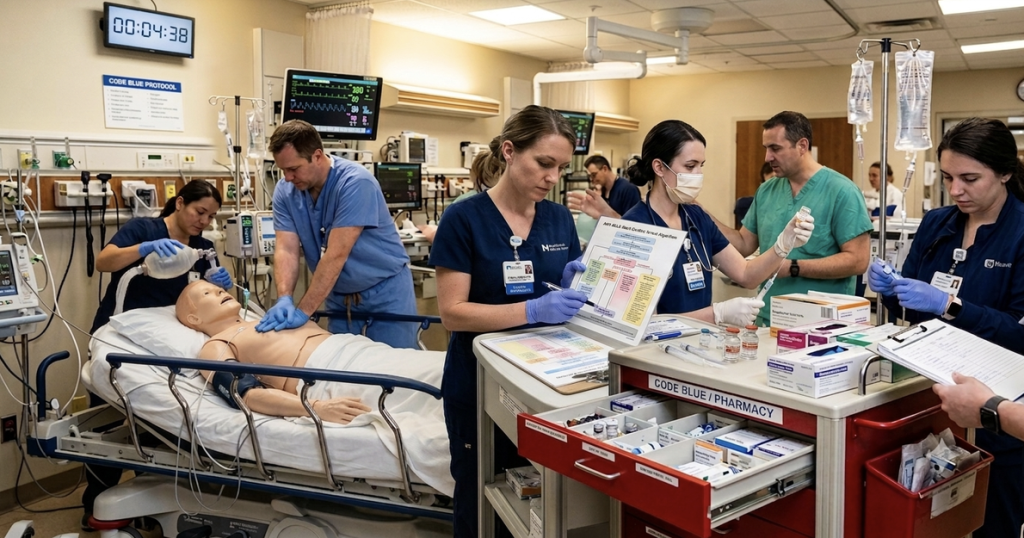
Picture a code team and you probably picture nurses and a physician calling the shots. That picture’s out of date. At a lot of hospitals now, there’s a pharmacist standing right there too — and increasingly, it’s not optional.
If you’re a hospital pharmacist and you don’t have ACLS yet, get it. Not because a policy memo told you to. Because you’re going to end up in that room eventually, whether it’s written down anywhere or not, and you don’t want to be learning epi timing live while someone’s coding in front of you.
Why You’re Ending Up on the Code Team Whether It’s Official or Not
Somebody has to own the drugs during a code — dosing, timing, the interaction nobody else on the team is thinking about in the moment. That’s usually you. ICU pharmacists, ED pharmacists, pharmacy residents rotating through critical care: a lot of health systems have already made this official policy. Plenty haven’t. Doesn’t matter. If you’re anywhere near critical care, you’re already expected to keep up.
This isn’t hypothetical. Someone’s pushing amiodarone after the third shock. Someone’s tracking whether epi went in on time for a PEA arrest. If that someone is you, you need to be inside the algorithm already — not reading it off a card for the first time mid-code.
What’s Actually Different for You vs. a Nurse or a Physician
The algorithm doesn’t change based on your badge. Same rhythms, same drugs, same timing windows, same certification. What changes is where your head goes during a code.
A nurse or a physician knows the algorithm says amiodarone after the third shock in refractory VF. You’re the one who knows that might be the wrong call for a patient already on three QT-prolonging meds. That’s not extra credit. That’s the reason you’re standing in that room instead of watching from the pharmacy.
The Credit Question
Not every ACLS course gives you credit you can actually use. ACI’s does. It’s accredited through the Postgraduate Institute for Medicine, and it awards ACPE credit alongside ANCC, ADA, and AMA PRA Category 1 Credit™. That’s not filler in a bullet list — it’s the difference between hours that count toward your own CE requirements and hours that just check a box for HR.
Fit It Around Your Actual Schedule
You don’t have a free afternoon for an in-person class between rotations. Nobody does. ACI’s course is online, self-paced, and takes about an hour if you sit down and focus. Pass the exam and your card is ready immediately — digital, ready to upload the same day. Retakes are unlimited, so there’s no reason to white-knuckle the exam either.
Bottom Line
ACLS for pharmacists isn’t a watered-down version of the real thing. It’s the same standard everyone else on the team is held to — you’re just the one who has to get the drug part right when it actually counts. Get certified before your hospital tells you to. Not after.
Frequently Asked Questions
Do pharmacists actually need ACLS certification? If you touch critical care, yes. A growing list of hospitals already require it for ICU, ED, and code-team pharmacists — and even where it’s not required yet, you don’t want to be the one figuring out the algorithm live during your first code.
Does ACI’s course count for ACPE credit? Yes. PIM-accredited, ACPE credit included, along with ANCC, ADA, and AMA PRA Category 1 Credit™.
Is the material different for pharmacists? No — same algorithms, same content everyone on the team learns. What’s different is what you’re actually on the hook for getting right: drug timing, dosing, interactions.
How long does it take? About an hour, online, at your own pace. Your card is ready the moment you pass.