In April 2026, the American Dental Association released its first comprehensive revision of its sedation and anesthesia guidelines in nearly a decade — adopted by the House of Delegates the previous October, developed jointly with seven other dental and medical organizations. Updated physical status classifications, new fasting recommendations, BMI added as a baseline vital sign, expanded supplemental oxygen requirements. Most of it is clinical housekeeping.
The part that should stop you is the emergency-credentialing section. It didn’t just get reaffirmed. It got sharper.
“Do Dentists Need ACLS?” Isn’t a Yes-or-No Question
Unlike a nurse or physician, a general dentist’s license doesn’t come with an ACLS mandate attached. What it comes with is a BLS requirement — near-universal across state boards, tied to your general license renewal, and required regardless of what procedures you perform.
ACLS and PALS work differently. They’re not a function of your license. They’re a function of your sedation permit. The moment you administer anything beyond minimal sedation, the requirement escalates — and it escalates specifically to what the ADA’s guidelines now spell out level by level.
What the Guidelines Actually Require, by Sedation Level
Minimal sedation: the administering dentist needs current BLS, and at least one additional staff member trained in BLS must be present. No ACLS requirement at this tier.
Moderate sedation: the administering dentist needs current BLS and current ACLS. If the patient is a child, current PALS is required as well — the guidelines specify it explicitly for “age-appropriate patients,” not as an optional add-on.
Deep sedation or general anesthesia: same BLS and ACLS requirement for the dentist, same PALS requirement for pediatric cases, plus a personnel minimum — at least three individuals present, two of whom must hold current BLS.
And across every tier, the guidelines now call for documented emergency drills, rehearsed at minimum every six months. Not read-through-the-protocol-once. Rehearsed, and recorded.
The Pediatric Pinch Point
The ADA has directed an ad hoc committee to build dedicated pediatric sedation guidelines, and until that work is finalized, existing recommendations from the American Academy of Pediatric Dentistry govern pediatric cases. AAPD’s current policy on office-based deep sedation and general anesthesia is specific: both the operating dentist and the anesthesia provider must hold current PALS or APLS. Supporting staff need BLS, PALS, or APLS. Recovery personnel need training in advanced resuscitative technique and have to maintain continuous monitoring until the patient meets discharge criteria.
If pediatric patients are any part of your sedation practice, PALS isn’t a credential you renew when convenient. It’s a permit-holding requirement, and a lapse doesn’t just flag a CE audit — it can pull your ability to sedate pediatric patients until it’s cured.
Credit That Doesn’t Count
Two accreditation systems carry real weight with dental boards: ADA CERP and AGD PACE. A course without one of those behind it may not satisfy your board’s CE requirement, even if the content is accurate and the certificate looks official.
Format matters too, and it varies by state and by certification. Some boards accept online ACLS and PALS coursework outright. Others — California’s among them — require BLS specifically to include a live, in-person skills practice session and skills test; an online-only BLS course won’t satisfy that requirement no matter how strong the accreditation behind it. Don’t assume your state treats every certification in your file the same way. Confirm the format requirement with your board before you enroll, not after.
Building a Credentialing File That Holds Up
Start with the tier your permit actually sits in — minimal, moderate, or deep sedation/general anesthesia — and match your certifications to that tier, not to whatever a colleague down the hall happens to hold. A permit upgrade without the matching ACLS or PALS on file is the fastest way to stall an application.
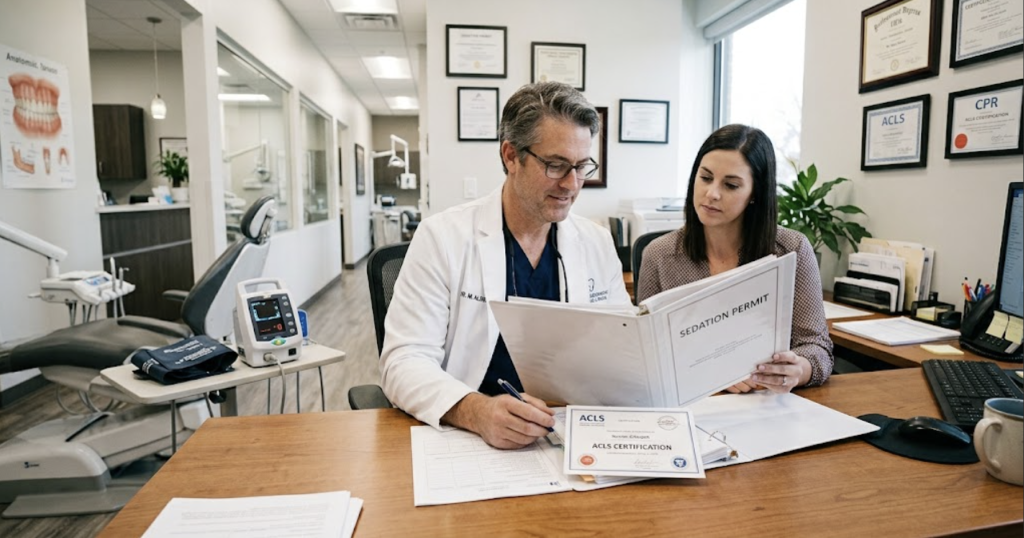
Treat a lapse on a permit-linked certification as a practice-stopping event, not an administrative one. Where possible, align your BLS, ACLS, and PALS renewal dates into a single window instead of tracking three separate expirations. And save every certificate the day you earn it — a credentialing coordinator or board auditor asking for documentation on short notice isn’t the moment to discover a provider you used years ago no longer exists.
Bottom Line
The ADA’s April 2026 update didn’t lower the bar on emergency preparedness — it defined it more precisely, and it put a six-month rehearsal cadence behind it. If your sedation or GA permit already requires ACLS or PALS, treat this as the moment to confirm your certifications, your accreditation, and your drill documentation actually match what’s now written into the guidelines your board is working from.
Advanced Certification Institute provides 100% online ACLS, PALS, and BLS certification and recertification for healthcare professionals — including ADA-recognized continuing education credit for dental professionals — built around your schedule. Explore our courses.
Use code BLOGREADER for a discount off your next order!