On May 5, 2026, the American Academy of Pediatrics published an updated policy statement and companion technical report on emergency preparedness in the pediatric office — the first full replacement of guidance that had stood since 2007. The prior version handed every pediatric practice the same checklist regardless of what that practice actually saw walk through its door. The 2026 update retires that approach and replaces it with something closer to a required self-assessment: build your office’s emergency readiness around your own patient population, your own layout, and your own distance from EMS, not a generic list.
That shift changes what “compliant” actually looks like for a pediatric office, and it changes how a practice should be reading its own certification and equipment list against the new standard.
From One-Size-Fits-All to Individualized
The core of the update is a structured assessment every practice is expected to run, not just consult. It asks a practice to work through the emergencies it’s actually likely to see — respiratory distress, seizures, anaphylaxis, psychiatric crises — against its own office layout, its own staff roles during a response, and the real-world response time of local EMS. A single-physician practice in a dense urban area with a hospital six minutes away is a different readiness problem than a multi-site subspecialty practice twenty minutes from the nearest ED, and the 2026 framework is built to produce different answers for each of them rather than one shared checklist.
That’s the headline change. Two decades of “here’s the list every pediatric office should have” becomes “here’s how every pediatric office determines its own list.”
What the Certification Recommendation Actually Says
BLS for all clinical staff remains the floor — that part hasn’t moved. What’s different is what sits above it. Rather than naming one required course for pediatric emergency response, the updated policy directs practices to consider Pediatric Advanced Life Support, Advanced Pediatric Life Support, or Pediatric Emergency Assessment, Recognition, and Stabilization based on what that practice’s own risk assessment turns up.
That’s a meaningfully different instruction than “get PALS.” It means a practice’s self-assessment — patient acuity, procedures performed, EMS response time — is what should be driving which of those three courses (or which combination) actually gets assigned to which staff role, not a blanket rule applied the same way to every pediatric office in the country.
The Equipment Split: Essential vs. Additional
The updated policy organizes emergency equipment and medications into two tiers instead of one flat list. Essential items — airway management tools, oxygen delivery equipment, a defibrillator, monitoring equipment, and core medications including albuterol, epinephrine, dexamethasone, and naloxone — are the baseline every pediatric office is expected to stock and check on a schedule. A second tier of additional supplies, including IV access materials and advanced airway devices, is positioned for practices that carry longer EMS response times or a higher-acuity patient mix, matching the same individualized logic as the certification recommendation.
A practice’s equipment list should be a documented output of its own assessment, not a static list, since the same list that satisfies a practice attached to a hospital campus may under-equip one operating twenty minutes from the nearest ambulance response.
Annual, Simulation-Based — Not a Read-Through
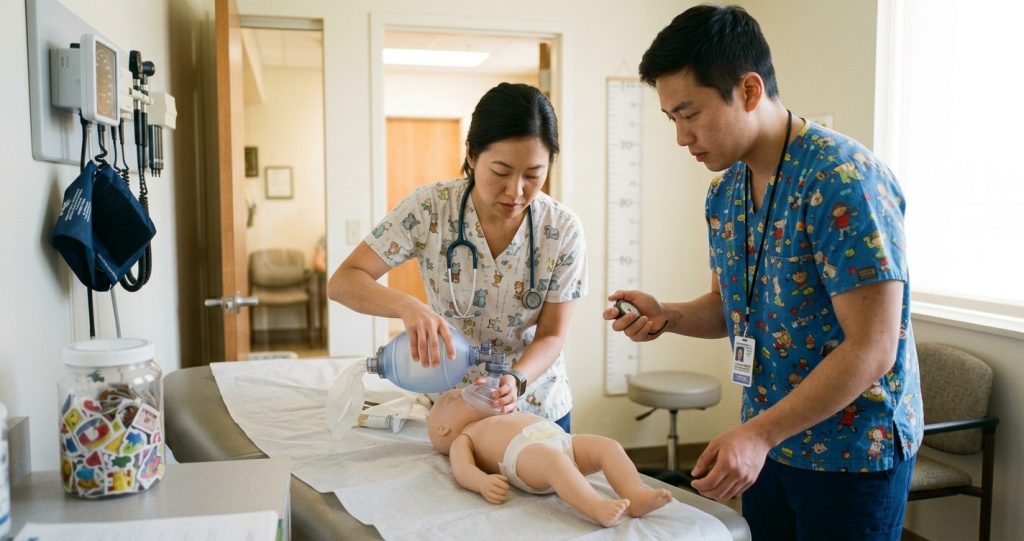
The 2026 update calls for simulation-based training at least annually, not a policy binder reviewed once and filed away. That framing matters: research on office-based mock codes has consistently found that simulation-based drills build staff confidence and response performance in ways a written protocol alone doesn’t, which is the underlying rationale for the shift from “have a plan” toward “rehearse the plan, on a schedule, with the actual people who’d run it.”
Building an Office That Meets the New Standard
Run the assessment first: patient population, common emergencies for that population, office layout, staff roles in a response, and actual local EMS response time. Let that assessment — not habit or what a previous employer did — determine which staff need PALS, APLS, or PEARS on top of the BLS floor, and which tier of equipment the office needs to stock.
Document the assessment itself, not just the resulting certification list and equipment inventory — a credentialing reviewer or a malpractice carrier evaluating readiness under the new framework will be looking for evidence that the individualized process happened, not just that a card is current. Schedule the annual simulation drill on the calendar the same way certification renewals are tracked, and treat it as a compliance item with the same weight, not an optional extra.
Bottom Line
The AAP didn’t add a new mandate on top of the old one — it replaced a shared checklist with a required process. A pediatric office’s real obligation under the 2026 update is to run its own assessment and be able to show its certification mix and equipment list are the documented output of that assessment, not an assumption carried over from 2007 guidance that no longer represents the current standard.
Advanced Certification Institute provides 100% online BLS, PALS, and ACLS certification and recertification for pediatric practices — built to help a whole office update its certification mix to match its own readiness assessment, on a schedule that doesn’t require closing for a training day. Explore our courses.
Use code BLOGREADER for a discount off your next order!