Basic Life Support certification is one of the most widely required credentials in healthcare — and one of the most misunderstood. Whether you are a nursing student preparing for clinical rotations, a dentist maintaining hospital privileges, or a pharmacist keeping credentials current, understanding what BLS certification is, what it covers, and how to obtain it properly will save you time and protect your career. This guide covers everything you need to know.
What Does BLS Stand For?
BLS stands for Basic Life Support. It is the foundational tier of emergency cardiac care — the knowledge and skills required to recognize and respond to life-threatening emergencies involving the heart and airway until advanced medical care arrives or is initiated. BLS is the clinical baseline; ACLS (Advanced Cardiovascular Life Support) builds upon it for more complex interventions.
What Is BLS Certification?
BLS certification is the formal credentialing process that confirms a healthcare provider understands and can execute Basic Life Support techniques. A certified BLS provider demonstrates competency in:
- Recognizing cardiac arrest and respiratory emergencies
- Performing high-quality CPR for adults, children, and infants
- Using an Automated External Defibrillator (AED) safely and effectively
- Providing rescue breathing and bag-mask ventilation
- Operating effectively as part of a two-person CPR team
- Managing foreign body airway obstruction (choking) in adults, children, and infants
BLS certification is grounded in the AHA’s 2020 Guidelines for CPR and Emergency Cardiovascular Care, as updated in 2025 with the latest ILCOR evidence review. ACI’s BLS curriculum reflects these current standards, designed and reviewed by Board Certified Anesthesia and Critical Care Physicians.
Who Needs BLS Certification?
BLS certification is the most broadly required clinical credential in healthcare. Unlike ACLS, which is primarily required for providers managing critical or emergency patients, BLS is expected of virtually every licensed healthcare professional. Professionals who routinely require BLS certification include:
- Registered Nurses (all specialties) and Licensed Practical Nurses
- Physicians and Physician Assistants (all specialties)
- Dentists, Dental Hygienists, and Dental Assistants
- Pharmacists and Pharmacy Technicians
- Physical and Occupational Therapists
- Medical Assistants and Clinical Support Staff
- EMTs and First Responders
- Nursing Students and Allied Health Students during clinical placements
Beyond healthcare, BLS certification is increasingly expected of school nurses, athletic trainers, fitness professionals, and others in roles where the risk of a medical emergency — even if rare — demands a prepared response.
BLS vs. CPR: What’s the Difference?
This is one of the most common questions around BLS certification. CPR (Cardiopulmonary Resuscitation) is a technique — the physical act of chest compressions and rescue breathing. BLS is a full certification that includes CPR but also covers AED use, two-rescuer scenarios, airway management, infant and child care, and an understanding of the broader Chain of Survival.
When a hospital or employer requires “BLS certification,” they mean the complete credentialing package — not a casual CPR class at a community center. ACI’s BLS certification meets the professional standard that clinical employers and credentialing bodies recognize and require.
What Does BLS Certification Cover?
ACI’s BLS course covers all competencies required for professional certification, organized around the core skills and knowledge a provider must demonstrate:
High-Quality CPR Technique
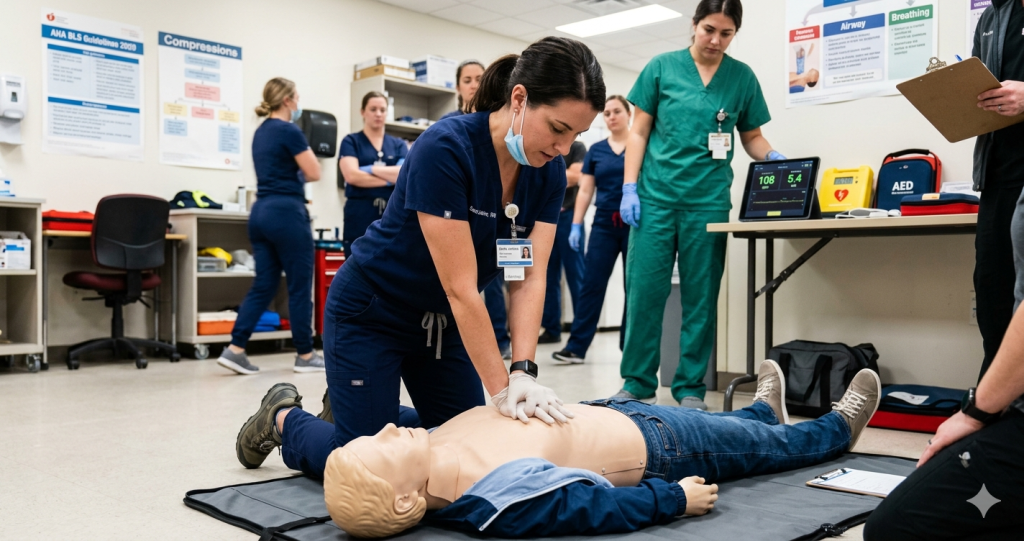
Effective CPR is not intuitive — technique matters enormously. ACI’s course covers compression depth (at least 2 inches for adults), compression rate (100–120 per minute), full chest recoil, and minimizing interruptions. These details reflect evidence that even small deviations from correct technique significantly reduce outcomes in real resuscitations.
AED Use
Automated External Defibrillators are available in most healthcare settings, airports, schools, and public spaces. BLS certification ensures providers know how to power the device, apply pads correctly, interpret voice prompts, deliver a shock safely, and immediately resume CPR following defibrillation.
Infant and Child CPR
Pediatric emergencies require different technique. BLS covers age-appropriate compression depth, two-finger technique for infants, and the unique considerations of managing airway obstruction in children and infants versus adults.
Two-Rescuer CPR
In a clinical environment, CPR is rarely performed solo. BLS certification teaches proper coordination between two rescuers, including compression-to-ventilation ratios, when and how to switch roles, and how to minimize compression pauses during transitions.
Airway Management Basics
BLS providers learn to use a bag-mask device (BVM) effectively, maintain proper head-tilt chin-lift positioning, and deliver adequate ventilations without over-inflating — a common and dangerous error in real resuscitations.
Recognition of Life-Threatening Emergencies
Acting quickly requires recognizing an emergency quickly. BLS training covers how to assess unresponsiveness, confirm absence of breathing or pulse, and initiate the correct response sequence — all within the critical first moments of a cardiac event.
How Long Is BLS Certification Valid?
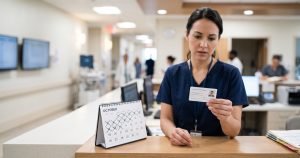
BLS certification is valid for two years. Recertification is required before the certification expires to maintain continuity of credentials. An expired BLS card can jeopardize employment, hospital privileges, and clinical placement. ACI’s BLS Recertification course is streamlined for busy professionals who already hold the foundational knowledge and simply need to renew.
Can You Get BLS Certification Online?
Yes. ACI’s BLS certification is fully online — no classroom attendance, no fixed schedule, no travel. You complete the course at your own pace, on any device, whenever it fits your schedule. The final exam must be passed to receive certification, and upon passing, your digital provider card is issued immediately.
ACI’s online BLS course does not require an in-person skills check-off. This is the format trusted by tens of thousands of healthcare professionals who cannot afford the scheduling friction of traditional in-person classes.
Is Online BLS Certification Accepted?
ACI’s BLS certification carries accreditation from five major professional bodies:
- AMA (ACCME) — accepted for physician CME requirements
- ANCC — accepted for registered nurses and advanced practice nurses
- AAPA — accepted for physician assistants
- ACPE — accepted for pharmacists
- ADA — accepted for dental professionals
This breadth of accreditation is unmatched in the online certification market. ACI’s credentials are recognized at major health systems across the country, including Mayo Clinic Health System, New York-Presbyterian, and St. Jude Children’s Research Hospital, among others.
Does BLS Certification Include CME Credits?
Yes. Every ACI BLS course includes Continuing Medical Education and Continuing Education Unit credits at no additional charge. For professionals tracking annual CME hours, completing BLS certification through ACI is an efficient way to earn required credits while maintaining a mandatory professional credential.
How Much Does BLS Certification Cost?
ACI offers some of the most competitive BLS pricing available online: Our Courses
Your digital provider card and CME/CEU credits are included at no extra cost.
Why ACI Is the Right Choice for BLS Certification
ACI’s BLS course is built by Board Certified Anesthesia and Critical Care Physicians — clinicians who understand exactly what life-threatening emergencies look like in practice, not just on paper. The curriculum is not adapted from a generic first aid template; it is designed from the ground up for professional healthcare providers who need accurate, clinically grounded training.
ACI’s adaptive testing technology further distinguishes the experience: when you answer a question incorrectly, the system links you directly back to the relevant course material. This ensures that certification reflects genuine competency — not a lucky score on a multiple-choice exam.
Get your BLS certification today at aciacls.com — 100% online, instant digital card, CME/CEU credits included, and the lowest prices online.