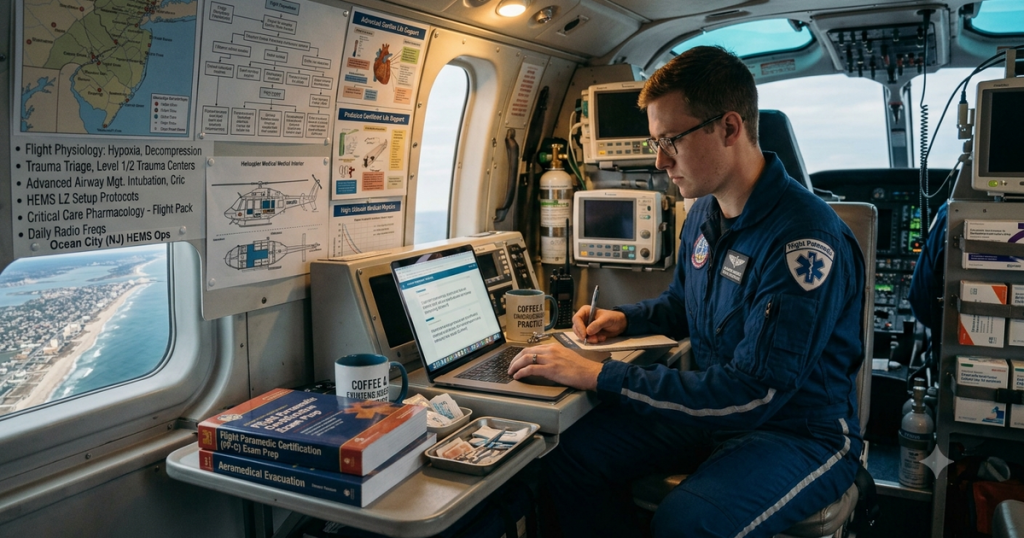
Flight paramedic credentialing is strict for a clinical reason: air medical crews operate with minimal backup, limited equipment footprints, and patients who are often the most unstable in their region. Every credential on a flight paramedic’s file exists because air medical leadership has decided the credential maps to something their crews will actually do at 2,000 feet with a dying patient. That’s the frame. Here’s what the requirements look like in practice, and where ACLS sits inside them.
What CAMTS and equivalent accreditors require
The Commission on Accreditation of Medical Transport Systems (CAMTS) sets the most widely used standards for air medical program accreditation in the U.S. CAMTS-accredited programs typically require their paramedic crew members to maintain:
- Active paramedic licensure in the state of operation.
- ACLS certification.
- PALS certification.
- BLS certification (in most cases; some programs treat ACLS as inclusive).
- A specialty credential such as FP-C (Flight Paramedic-Certified) from the International Board of Specialty Certifications (IBSC) or CCP-C (Critical Care Paramedic-Certified).
- Program-specific competencies: rapid sequence intubation, ventilator management, blood product administration, advanced hemodynamic monitoring, and hoist or rotor-wing safety.
Not every air medical program is CAMTS-accredited. Non-accredited programs may have slightly different requirements, but the baseline is usually very similar because state EMS offices and hospital partners impose comparable expectations.
Where ACLS fits in the credentialing stack
ACLS is one credential inside a much larger stack. For a flight paramedic, ACLS functions as documentation of core adult resuscitation competency — foundational, not differentiating. The FP-C and program-specific training are what differentiate flight crews from ground-level ALS. But ACLS is required, and a lapsed ACLS card will pull a flight paramedic off schedule faster than most other documentation gaps.
This means ACLS recertification for flight paramedics is about efficiency, not depth. You already know the algorithms. Your daily practice includes resuscitation at a level well above the ACLS baseline. What you need is a current, verifiable card that maps to your program’s credentialing policy — and you need it without losing a shift day to an in-person course.
The “skills test” question is different for flight than for floor nurses
Hospital-based ACLS policies sometimes require in-person skills assessment as part of credentialing. Air medical programs usually don’t — because air medical programs do their own skills assessments. Intensive annual or biannual recurrency training at the program level includes hands-on verification of CPR, intubation, defibrillator use, and program-specific equipment. That internal skills verification is more demanding than anything an AHA ACLS station would cover.
As a result, most air medical programs accept online ACLS as documentation, provided the issuer is reputable and the card is verifiable. The program’s own skills recurrency covers the hands-on component. The ACLS card satisfies the documentary requirement.
Confirm this with your program’s chief flight paramedic or clinical director before you enroll online. Ask specifically: does the program accept online ACLS certification from accredited providers? The answer is often yes. Get it in writing.
Fastest path to multi-cert compliance
Flight paramedics typically need ACLS and PALS on the same cycle, often with BLS separately or bundled. The efficient approach:
- Align ACLS and PALS expiration dates. Renew them in the same week to simplify tracking and credentialing documentation.
- Use a single issuer where possible. Bundled programs save documentation work and produce credit statements that are easier to file with your program’s clinical office.
- Stack recertification with your program’s annual recurrency cycle. Recert your online credentials in the same quarter as your program’s hands-on recurrency training — your documentation package goes in at once.
- Budget for FP-C or CCP-C recertification separately. These are program-specific credentials with their own CE requirements and renewal timelines, distinct from ACLS.
FP-C and CCP-C interact with ACLS differently
Your specialty credentials — FP-C from IBSC or CCP-C — are renewed on separate cycles with their own CE requirements. These are not replaced by ACLS, and ACLS does not replace them. But ACLS hours often contribute CE credit toward FP-C and CCP-C recertification, provided the credit type issued matches what IBSC accepts. Verify this with IBSC’s current CE guidance before you count ACLS hours toward your specialty recertification — the specifics evolve.
The practical framing: ACLS is your foundational documentation. FP-C or CCP-C is your specialty differentiator. Both need to be current. Neither eliminates the other.
Ground transport and interfacility critical care
If you’re cross-credentialed between air medical and ground critical care transport — increasingly common in rural and regional systems — your credentialing stack extends further: additional ACLS, PALS, and often specific courses like NRP (Neonatal Resuscitation Program) or TNCC (Trauma Nursing Core Course). The same efficiency principles apply: align renewal dates, use a single issuer where possible, submit documentation packages rather than individual cards, and build your calendar reminders around every credential simultaneously.
How ACI is built for the air medical credentialing environment
Confirm your program’s credentialing policy first. If your program accepts accredited online providers, ACI maps directly. Then stack your ACLS, PALS, and BLS on one cycle and move on.
ACI’s ACLS, PALS, and BLS certifications are designed by Board-Certified Critical Care physicians in collaboration with Certified instructors, based on current ILCOR, ECC, and AHA guidelines. Certification is 100% online, issued digitally on completion, verifiable through ACI’s portal, and valid for two years. Unlimited retakes. Priced for clinicians who need efficient, verifiable documentation without losing a shift day.
Save 5% on your certification with code BLOGREADER at checkout. Get ACLS Certified Today: www.aciacls.com