Written by Kate Fitzgerald, BSN, RN, Critical Care Nurse
Medically reviewed by Timothy Fitzgerald, MD, Board-Certified Anesthesiologist
Last reviewed: October 13, 2026
Once a patient is in cardiac arrest, every other distinction on the monitor stops mattering except one: is this rhythm shockable, or isn’t it? The eight rhythms every ACLS provider needs to recognize sort into exactly two arrest-rhythm categories once a pulse check confirms there isn’t one, and the entire ACLS Cardiac Arrest Algorithm is built around getting that one branch point right, fast.
This post is the synthesis piece for the rhythm series — it doesn’t introduce new waveforms so much as it draws the line that everything else in the series eventually runs into. Wide-complex tachycardia and narrow-complex tachycardia are differentials for a patient who still has a pulse. The moment that pulse disappears, the question changes entirely, and it only has two possible answers.
The Only Question That Matters Once There’s No Pulse
A pulse check during a code isn’t a formality — it’s the fork in the algorithm. A patient with no pulse is in cardiac arrest, and cardiac arrest resolves into one of two treatment paths based on a single read of the monitor: shockable, or non-shockable. There is no third path and no in-between. Every drug, every timing interval, and every subsequent decision in the algorithm sits downstream of that one classification.
Shockable Rhythms: VF and Pulseless VT
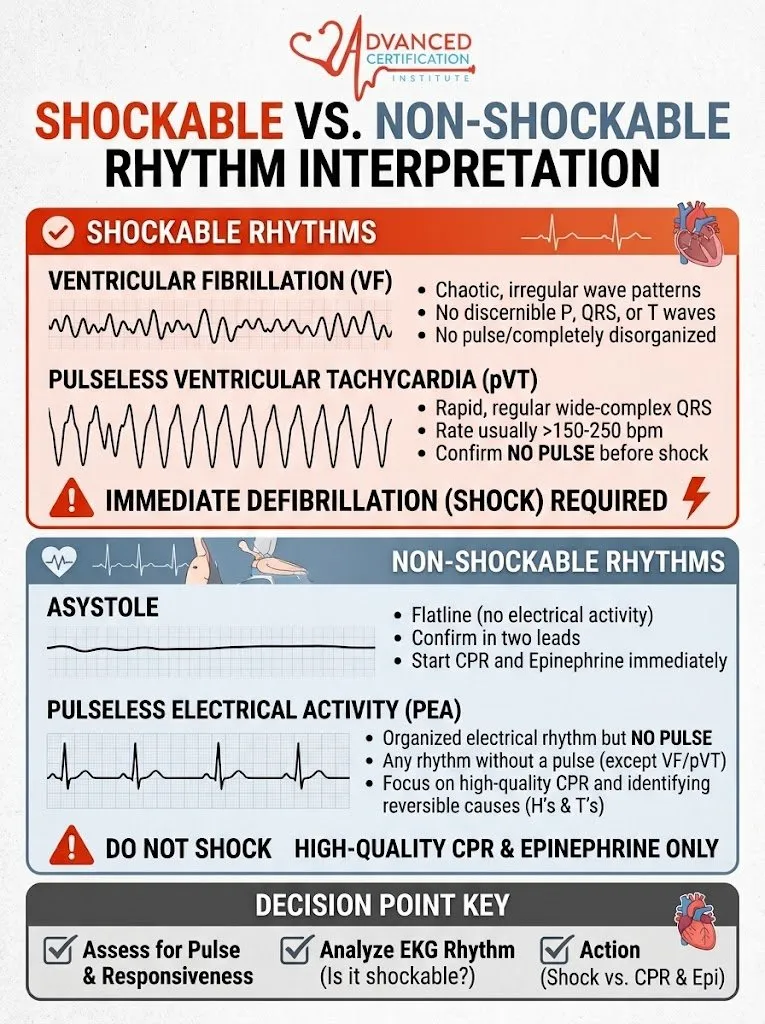
Ventricular fibrillation is a chaotic, disorganized waveform with no identifiable QRS complexes. There’s no ambiguity to resolve here — VF never produces a pulse, so the pulse check and the rhythm read agree completely.
Pulseless ventricular tachycardia is the other shockable rhythm, and it’s the one that requires an extra step VF doesn’t: VT can appear on the monitor with a pulse or without one, and the two are managed completely differently. Only the pulseless version belongs in the arrest algorithm. A wide, fast, organized rhythm with no pulse is treated exactly like VF.
What to do for either: Defibrillate immediately. CPR resumes right away before and after the shock, with the pre-shock and post-shock pauses kept as short as possible — every second compressions aren’t running is a second of lost perfusion. Epinephrine every 3 to 5 minutes, and if the rhythm persists after the first shock, amiodarone or lidocaine per the algorithm. Rhythm and pulse are reassessed roughly every 2 minutes, not continuously, so CPR isn’t interrupted more than it has to be.
Non-Shockable Rhythms: Asystole and PEA
Asystole is a flat line — no electrical activity at all. Before calling it, confirm the flatline in more than one lead and check that the leads are actually connected; a disconnected lead looks identical to asystole on the monitor, and that’s a mistake worth ruling out before committing to the non-shockable path.
Pulseless electrical activity is the harder one to accept in the moment, because the monitor can show a rhythm that looks entirely organized, sometimes entirely normal, while the patient has no pulse. The electrical system is firing correctly; something else is preventing that electrical activity from producing a mechanical contraction strong enough to generate a pulse.
What to do for either: CPR and epinephrine, started as early as possible and continued without defibrillation. The real work in both cases is working through the H’s and T’s — the reversible causes of arrest — because neither asystole nor PEA resolves reliably without finding and correcting whichever one is driving it. That search deserves its own post; the short version is that it’s a systematic checklist, not a guess, and it runs in parallel with CPR rather than instead of it.
Why Shocking a Non-Shockable Rhythm Does Nothing
Defibrillation works by depolarizing a critical mass of heart muscle simultaneously, which interrupts the chaotic electrical activity of VF or the rapid, ineffective circuit of pulseless VT long enough for the heart’s own pacemaker to take back over. That mechanism only has something to act on when there’s disorganized or ineffective electrical activity to interrupt.
Asystole has no electrical activity at all, so there’s nothing for a shock to interrupt — defibrillating a flat line doesn’t organize it, and it doesn’t help. PEA already has organized electrical activity; the problem isn’t the rhythm, it’s whatever is blocking that electrical signal from producing an effective contraction. A shock doesn’t touch that problem either. In both cases, stopping compressions to deliver a shock that can’t help is worse than doing nothing — it’s lost CPR time traded for no benefit at all.
The Rhythm Check Cadence
The algorithm checks rhythm and pulse roughly every 2 minutes, not more often, and for a specific reason: every pause in compressions drops coronary and cerebral perfusion pressure, and it takes several more compressions to rebuild it than the pause itself lasted. Rhythm checks, pulse checks, and shocks are bundled into the smallest possible interruption, compressors rotate every 2 minutes before fatigue degrades compression quality, and nothing about the non-shockable path changes that cadence — it just removes the shock from the sequence.
Where the Rest of the Series Fits
Mobitz I, Mobitz II, and third-degree heart block are bradyarrhythmias managed with atropine and pacing, not arrest rhythms, unless one deteriorates into a rhythm that stops producing a pulse. Torsades de pointes, wide-complex tachycardia, and narrow-complex tachycardia are all differentials for a patient who still has a pulse to lose. The moment any of them cross into pulselessness, this post is where they land — torsades and other polymorphic VT as shockable, and a bradyarrhythmia that progresses to PEA as non-shockable. The shockable/non-shockable split isn’t a ninth rhythm to memorize; it’s the filter every other rhythm in this series eventually passes through.
Bottom Line
Cardiac arrest management reduces to one branch point: shockable or not. VF and pulseless VT get immediate defibrillation because there’s disorganized or ineffective electrical activity for a shock to interrupt. Asystole and PEA get CPR, epinephrine, and a search for a reversible cause because there isn’t. Every other decision in the algorithm — drug timing, rhythm check intervals, when to shock again — sits downstream of getting that one call right, which is why it has to be automatic, not worked out mid-code.
Advanced Certification Institute (ACI) provides online ACLS, PALS, and BLS certification and recertification for healthcare professionals, built around the current AHA/ILCOR guidelines. Explore ACI’s ACLS courses.
Save on your certification with code BLOGREADER at checkout. Get ACLS Certified Today: www.aciacls.com